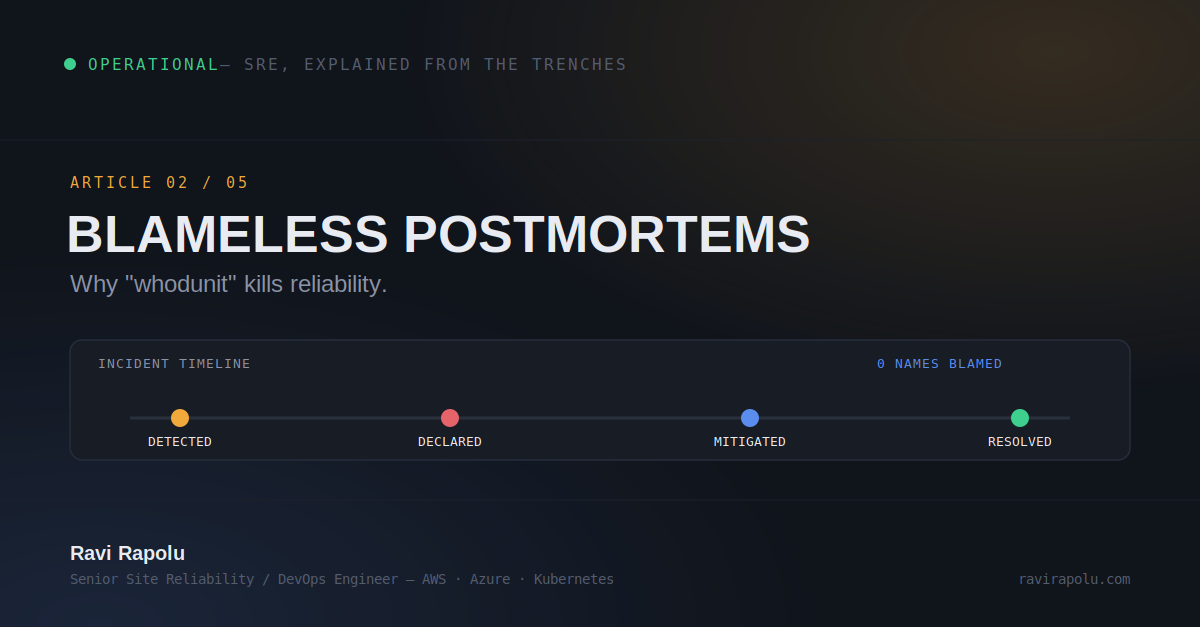
The fastest way to guarantee your next outage is worse than your last one? Punish the person who reported this one honestly.
The problem
Every team says they want a “learning culture.” Most don't have one — they have a blame culture wearing a lanyard that says “learning culture.” The tell is simple: when something breaks, does the conversation start with “what happened” or “who did it”? The moment postmortems become about finding a name to attach to the failure, people stop reporting near-misses, stop flagging their own mistakes early, and start writing incident tickets designed to protect themselves instead of explain the system.
What blameless actually means
Blameless doesn't mean consequence-free. It means the postmortem assumes every person involved made the most reasonable decision they could, given what they knew at the time. The question isn't “why did you do that” — it's “what did the system let you believe, and how do we fix that.”
A good blameless postmortem separates three things: the timeline (what happened, second by second), the contributing factors (what made the failure possible — not who), and the actions (what changes, systemically, so this class of failure gets harder).
How I've applied it
Partnering with SIAM and incident management teams on high-severity response, the postmortems that actually reduced MTTR long-term were never the ones that ended in someone getting reassigned. They were the ones where an engineer said “I saw a warning sign and didn't escalate it” without fear — because that's the sentence that reveals where your monitoring or your escalation path is actually broken.
Takeaways
- If people are afraid to be honest in a postmortem, your postmortem data is fiction
- Blameless doesn't mean nobody's accountable — it means the system is accountable first
- Track “contributing factors,” not “root cause” — most outages don't have one root cause
- The best postmortems produce action items with owners and dates, not just narratives
- Psychological safety isn't a soft skill here — it's a reliability engineering input
Ravi Rapolu is a Senior Site Reliability / DevOps Engineer, currently open to AWS / Azure platform engineering and AIOps / LLMOps roles.
Connect on LinkedIn ↗ → page Ravi