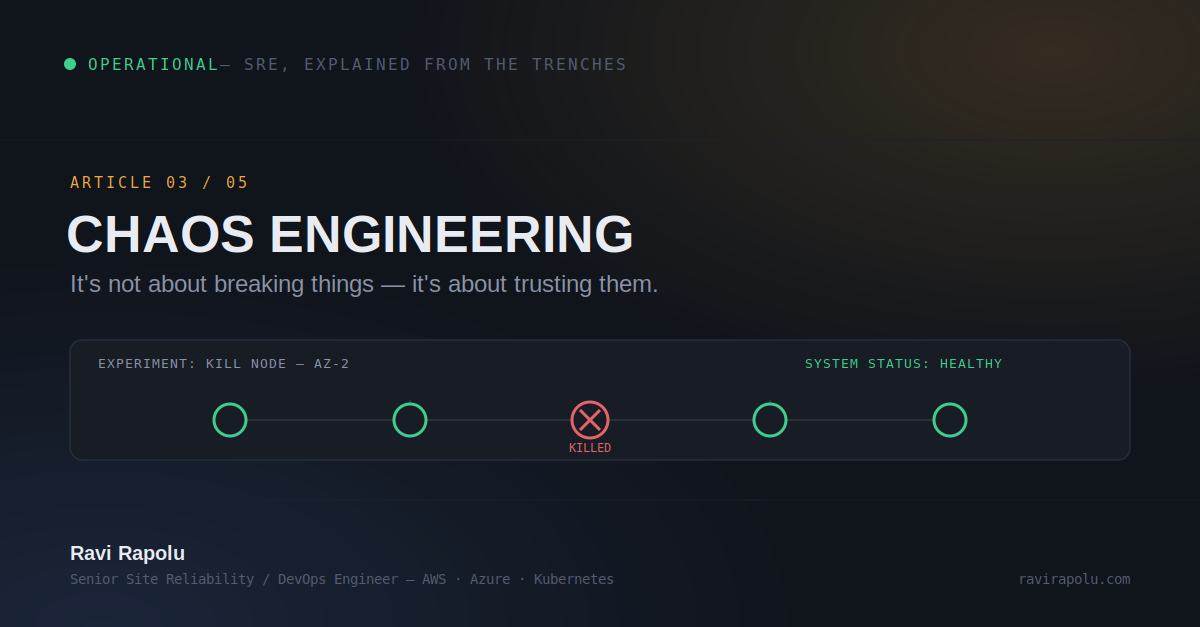
If you've never deliberately broken your production system, you don't actually know if it's resilient. You're hoping.
The problem
Most teams' disaster recovery plan is a document nobody's read since it was written, describing a failure scenario nobody's tested since the architecture changed twice. Confidence in “we can handle a failover” is almost always untested confidence — right up until the day it's tested by an actual outage, at the worst possible time, in front of the worst possible audience.
What chaos engineering actually is
Chaos engineering is the discipline of injecting controlled failure into a system on purpose, in order to find weaknesses before they find you. Kill a node. Throttle a network call. Simulate an AZ going down. Do it in a controlled window, with a rollback plan, and watch what actually happens versus what your architecture diagram claims should happen.
The goal isn't chaos for its own sake — it's converting “we think this is resilient” into “we've watched this survive,” on your terms, not the internet's.
How I've applied it
Running Chaos Engineering programs with Gremlin and Azure Chaos Studio against Tier 1 and Tier 2 systems surfaced failure modes that no architecture review ever caught — the kind of thing where a service degrades gracefully on paper but cascades in practice because of one assumption nobody documented. Every one of those findings became a fix made calmly, on a Tuesday afternoon, instead of during a 2am page.
Takeaways
- Untested resilience is a hypothesis, not a fact
- Start small — kill one non-critical service before you touch Tier 1
- Chaos experiments need a blast radius and a rollback plan, always
- The best time to find a single point of failure is when you caused it on purpose
- If leadership is nervous about chaos testing, that nervousness is your best argument for why you need it
Ravi Rapolu is a Senior Site Reliability / DevOps Engineer, currently open to AWS / Azure platform engineering and AIOps / LLMOps roles.
Connect on LinkedIn ↗ → page Ravi