If your team's biggest flex is how fast you can respond to an outage, you've optimized the wrong thing.
The problem
Fast incident response feels like competence. Often it's actually a symptom — a sign that the same class of failure keeps happening and the team has just gotten really good at putting it out. Every 2am page that gets resolved by “restart the service” is a page that shouldn't have needed a human at all.
What self-healing infrastructure actually is
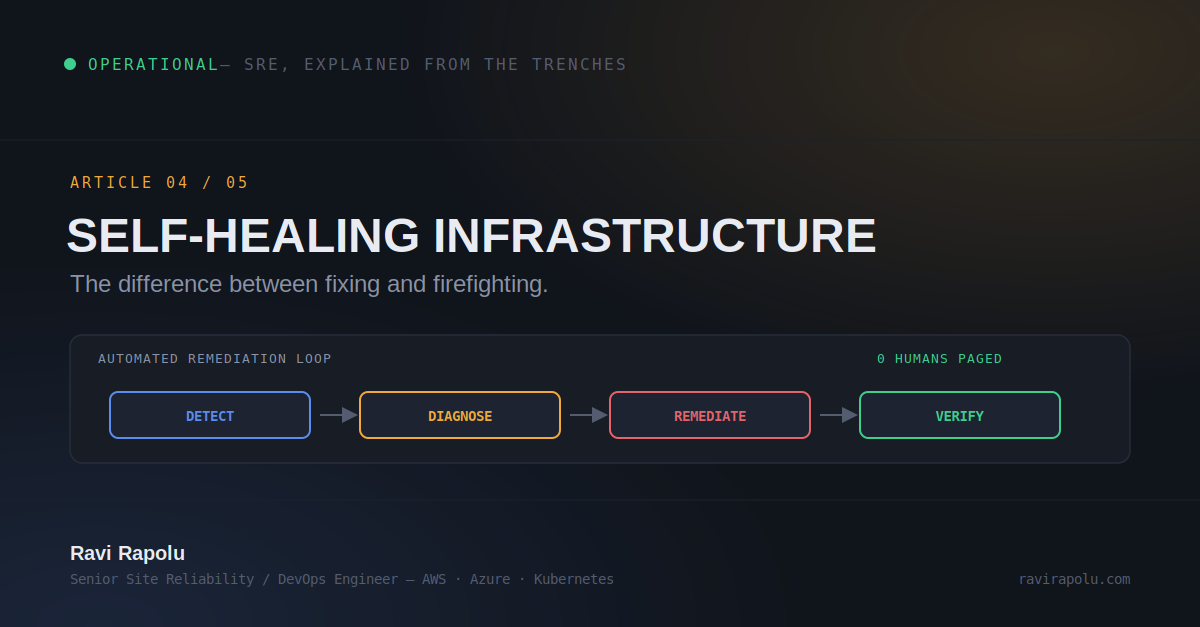
Self-healing infrastructure is built to detect and remediate known failure patterns without waiting for a person to wake up. That's not magic — it's the accumulation of boring, deliberate engineering: infrastructure as code that makes environments reproducible instead of hand-tuned, automated health checks that trigger real remediation (not just alerts), and configuration management that prevents drift instead of just reporting it after the fact.
The mental shift is treating every manual fix as unfinished work. If a human did it once, ask whether a script should do it next time.
How I've applied it
Leading the shift to self-healing infrastructure using Terraform, Ansible, Puppet, and Packer measurably cut operational toil — engineers stopped being pulled into repetitive remediation and got their time back for actual feature and reliability work. The pattern was always the same: notice a recurring manual fix, automate the detection, automate the remediation, and delete a category of pages from the on-call rotation entirely.
Takeaways
- Every recurring manual fix is a backlog item, not a badge of honor
- Infrastructure as code isn't about speed — it's about making failure boring and repeatable to fix
- Configuration drift is often the real root cause hiding behind “it worked in staging”
- Measure toil the same way you measure downtime — it's a leading indicator
- The best on-call shift is the quiet one, and that's earned, not lucky
Ravi Rapolu is a Senior Site Reliability / DevOps Engineer, currently open to AWS / Azure platform engineering and AIOps / LLMOps roles.
Connect on LinkedIn ↗ → page Ravi